When to Hire a Brand Designer: The Point Where DIY Branding Stops Being Enough

Building your own brand is not automatically a mistake.
For a new business, it can be exactly the right place to start.
You may need a name, a simple identity, a website and enough visual consistency to begin selling. If the offer is still changing, the audience is still being tested and the business model is not fully settled, investing heavily in a complete identity system may be premature.
And in 2026, founders can do much more themselves.
You can build a website, generate imagery, create social content, edit video, assemble presentations and test different visual directions without hiring a specialist every time something needs to be made.
That changes the role of a brand designer.
It does not remove it.
The useful question is no longer:
Can I make this myself?
In many cases, you can.
The better question is:
Has the business reached the point where making every brand decision yourself is starting to slow it down?
That is usually where professional brand design becomes useful.

DIY branding is often enough at the beginning
I do not think every business needs a full identity system from day one.
If you are still validating a product, adjusting the offer or learning who actually buys from you, a lightweight identity can give you the flexibility you need.
The problem usually appears later.
The company changes, but the identity does not.
A brand created for one product now has six.
A simple website becomes ecommerce, campaigns, email, wholesale material and landing pages.
A founder who once created everything personally now has a developer, marketer, packaging supplier or freelancer making decisions too.
The price moves up, but the brand still communicates the stage the business was in two years ago.
Nothing may look dramatically broken.
The original identity has simply been asked to do a job it was never built for.
That is the point worth paying attention to.
1. Every new asset requires another round of brand decisions
One of the clearest signs is that the same questions keep coming back.
A new landing page needs a layout, so you choose one.
A product launches, so you decide where the logo goes, which color belongs to the variant and how the hierarchy should work.
Then somebody needs a sales deck.
Then an email campaign.
Then retail material.
Then a second product format.
Everything may look acceptable individually, but each piece has been designed as a separate answer.
This often creates a brand that depends on taste rather than rules.
You know when something feels right because you have been making the decisions from the beginning. Other people do not have that context.
A brand identity system turns those instincts into something repeatable.
It defines how typography, color, image direction, layouts, hierarchy and brand assets should behave so every new application does not require another miniature redesign.

2. The business has become stronger than the identity around it
This is common in businesses that grow gradually.
The first identity did its job. It helped you launch.
Since then, the product has improved. The service is more sophisticated. The customer may be different. The price may have increased considerably.
But the visual identity still reflects the earlier version of the company.
That gap matters most when perception is part of the buying decision.
A premium skincare line can have a strong formulation and still look uncertain when the packaging hierarchy feels improvised.
A high-trust healthcare or professional service can have excellent expertise while the website makes the business feel less established than it is.
A product brand can raise its price while the identity still communicates the entry-level positioning it launched with.
This does not necessarily mean you need a new logo.
Sometimes the logo is perfectly usable.
The problem is that the wider system has never caught up.
3. The brand now has to work across more places
A visual identity can remain very simple when it only needs to support a website and a handful of social posts.
Complexity changes the problem.
Now the brand may need to work across:
packaging
ecommerce
retail
email
campaigns
presentations
printed materials
events
wholesale
new product ranges
external suppliers
That is no longer a question of making individual pieces look good.
It is a question of creating rules that survive across all of them.
Packaging makes this especially obvious.
One product can be designed almost independently.
A growing range cannot.
By the fifth or tenth SKU, you need to know what stays fixed, what changes, how variants are distinguished, where claims belong, how master-brand recognition is preserved and what happens when a completely new format enters the range.
Without that architecture, every launch starts to solve the same problem again.

4. You can produce more options, but deciding between them is getting harder
Modern tools are very good at giving you possibilities.
You can test different fonts in minutes.
Generate multiple image directions.
Rebuild a homepage.
Create dozens of references.
Try different packaging colors before lunch.
The bottleneck is increasingly not production.
It is judgment.
Which direction actually supports the positioning?
What should remain recognizable?
Is the identity genuinely wrong, or has it simply been applied inconsistently?
Will making the brand look more premium strengthen perception, or make it feel disconnected from the customer?
Is packaging the real problem, or does the range lack hierarchy?
Does the business need a new identity, or clearer rules around the one it already has?
This is where an experienced brand designer should become useful.
Not because the business needs somebody to produce more options.
Because it needs somebody to reduce the number of unresolved decisions.
5. Other people are now using the brand
A founder can keep an incomplete identity surprisingly consistent.
A lot of the brand exists in your head.
You know which image feels wrong.
You know which shade is the correct one.
You know the logo should not be that large.
You know which old Canva template everyone should ignore.
That stops working when more people become involved.
A marketer creates campaign graphics.
A developer builds a landing page.
A supplier prepares packaging artwork.
A freelancer makes social assets.
A retailer needs product materials.
Each person fills in the missing rules slightly differently.
Over time, the brand begins to split into versions of itself.
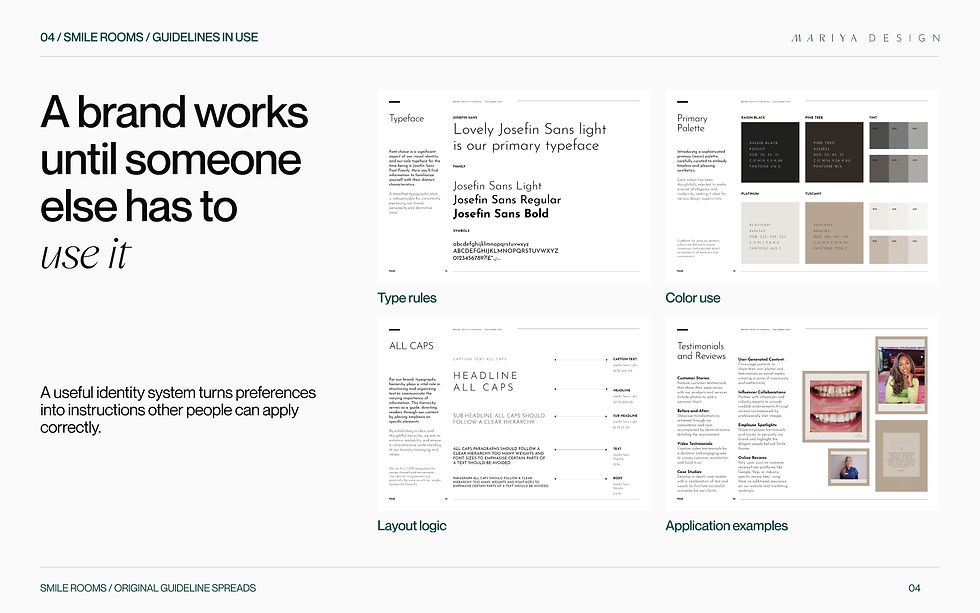
This is where guidelines stop being a decorative PDF and become an operational tool.
A useful identity system should make the brand less dependent on the founder personally approving every crop, font size and color choice.
6. You are preparing for a bigger commercial step
Sometimes nothing is visibly broken yet.
The trigger is what the business is about to do.
You may be preparing to:
launch a significant new product
enter retail
approach distributors
increase pricing
expand into another market
introduce a larger product range
open a physical location
build a wholesale presentation
move from founder-led execution into a wider team
Those moments put more pressure on the identity.
It is usually cheaper to review the system before investing in twenty new applications than to discover halfway through the rollout that the foundation cannot support them.
That does not mean every growth stage requires a rebrand.
It means the identity should be able to support the stage you are moving into.
7. You are spending too much time maintaining consistency
This is the practical cost that is easiest to miss.
How often are you answering questions like:
Which logo file should we use?
Which typeface is correct?
Can this color change?
How should this new SKU fit into the range?
Why does the website feel different from the packaging?
Which template is current?
Why does every campaign need a new visual direction?
Where are the production files?
Why does the supplier keep making the same mistakes?
At that point, the business may already be paying for the absence of a system.
Just not through a branding invoice.
It is paying through founder oversight, duplicated work, inconsistent suppliers, redesigns, slow approvals and decisions that have to be made again every time the brand expands.
So when should you hire a brand designer?
Not automatically when you start a business.
And not because professional branding is something a serious company is supposed to buy.
The stronger moment is when the business has enough clarity and enough complexity for the design decisions to matter.
You know what you sell.
You have a clearer idea of who it is for.
You understand where the brand needs to operate.
You can see what has changed since the original identity was created.
And the brand now needs to support the next stage of the business rather than simply help it exist.
That is a much better foundation for professional brand work.
What should a brand designer actually leave you with?
Hopefully, something more useful than a better-looking logo.
For the brands I work with, the real value is usually in building the structure around the identity.
Depending on what the business needs, that may include:
logo and brand assets
typography
color roles
layout principles
image direction
packaging architecture
product and variant hierarchy
digital behavior
application rules
templates where scoped
brand guidelines
supplier guidance for the agreed deliverables
The exact deliverables change from project to project.
The objective is consistent:
you should leave with fewer unresolved brand decisions than you started with.
The system should make future execution easier.
A new product should not force the brand to reinvent itself.
A new landing page should not require a completely different visual direction.
A supplier should have enough information to work accurately.
A developer should not need to reconstruct the brand from screenshots.
And your team should not depend on you personally correcting every asset before it can go live.
You may not need a full rebrand
Reaching the limit of DIY branding does not automatically mean starting again.
Sometimes the identity has useful recognition but needs stronger rules.
Sometimes the design itself is not the problem. The applications have simply drifted.
Sometimes the positioning needs to be clarified before any visual work begins.
Sometimes the packaging system is breaking while the wider identity remains usable.
Sometimes an early-stage business needs a clearer direction before investing in execution.
And sometimes the existing identity genuinely has reached its limit.
The right first step is therefore not always redesign.
It can be diagnosis.
At Mariya Design, I separate those situations deliberately.
An existing brand that needs clarity before making larger changes may begin with a Strategic Brand Audit.
A new or early-stage brand that needs to establish its direction before design may begin with the Brand Direction Blueprint.
A brand ready for a complete identity system can move into The Vault.
The point is not to replace more than necessary.
It is to understand which decisions are actually holding the brand back.
The next stage of the brand should make the business easier to run
Professional branding should not create permanent dependence on a designer.
A good system should do the opposite.
It should make the brand easier to recognize, easier to extend and easier for other people to use correctly.
You should know what can change and what should remain consistent.
New products should feel related to existing ones.
Packaging, website, presentations and campaigns should belong to the same business.
Your suppliers should have clearer instructions.
Your team should have fewer questions.
And you should be able to spend less time policing the brand and more time using it.
That is usually the point where hiring a brand designer makes sense.
Not because you can no longer make things yourself.
Because the business has reached the stage where the decisions behind those things need a stronger system.

Has your brand reached that point?
If your business has outgrown the identity it started with, tell me what has changed, where the brand is struggling and what you are trying to do next.
I’ll review the context and point you toward the most relevant starting point.


