Why Your Brand Is Not Converting, Even If It Looks Good
- Mariya Vasileva

- Feb 22
- 6 min read
Updated: 2 days ago
Your brand does not look broken.
The logo is clean. The colors are mostly consistent. The website works. The product looks credible. The visuals may even feel premium in isolation.
But conversion is still inconsistent.
Traffic does not turn into enough inquiries. Paid campaigns feel harder to justify. Product interest does not become action. People seem interested, but hesitate. The brand looks good, but does not create enough clarity or trust.
That gap is usually not caused by one bad design asset.
It usually appears when the brand looks polished, but the structure behind the customer experience is unclear.
A brand can look good and still fail to convert if the message, hierarchy, perception, and execution do not work together.

Good-looking design does not guarantee conversion
Founders often judge a brand by how it looks.
Does it feel modern? Does it look premium? Does the website seem clean? Does the packaging photograph well? Does the content look polished?
Those things matter.
But customers do not convert because a brand looks nice.
They convert when the brand makes the right decision feel clear, credible, and low-risk.
That requires more than visual polish.
It requires:
clear positioning
strong hierarchy
aligned messaging
consistent touchpoints
credible product presentation
enough trust signals
a smooth path from attention to action
When these pieces are not aligned, conversion becomes fragile.
The brand may look good at first glance, but the customer experience feels uncertain.
Where conversion usually breaks
Conversion problems often appear across the journey, not inside one isolated page.
A common pattern looks like this:
An ad creates interest. The landing page uses a different tone. The product page explains the offer differently. The packaging suggests another level of quality. The email sequence shifts the message again. The sales deck feels like a separate version of the brand.
Each asset may look acceptable on its own.
Together, they create friction.
The customer has to work harder to understand what the brand stands for, why it matters, what makes it credible, and what action to take next.
That hesitation affects conversion.
Not because the design is ugly.
Because the experience is not clear enough.

The illusion of a polished brand
A polished brand can hide structural problems.
The website may look clean, but fail to prioritize the right information. The packaging may look premium, but not connect clearly to the brand’s digital presence. The social content may look attractive, but weaken the authority of the offer. The product page may show the product well, but not explain why it is worth choosing. The brand may feel expensive, but not necessarily trustworthy.
This is especially dangerous for premium and luxury-led brands.
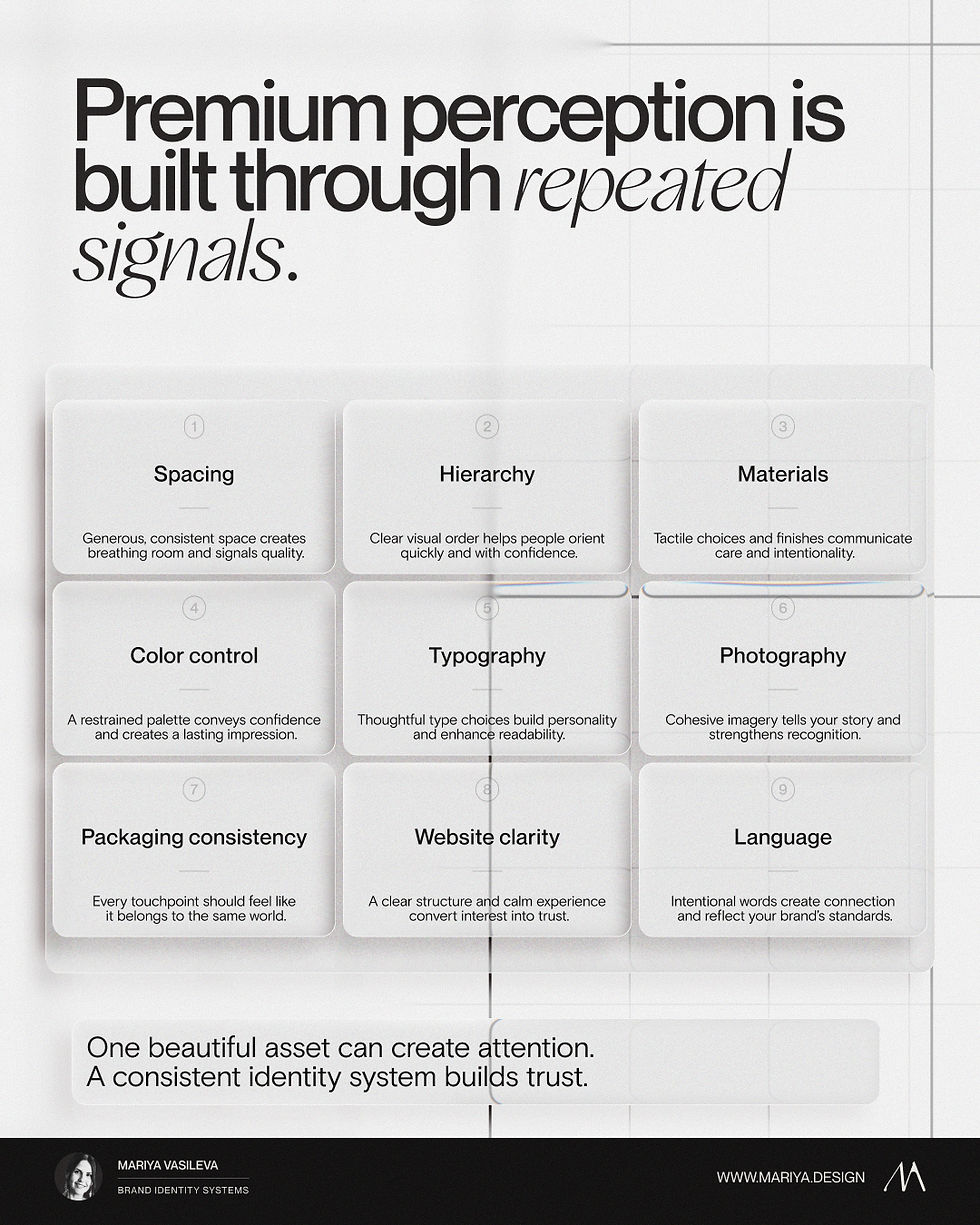
Premium perception is built through repeated signals.
When those signals do not align, the brand may look visually elevated but still feel uncertain.
A customer may not consciously think, “This brand lacks a system.”
They simply hesitate.
They do not understand the value quickly enough. They do not feel enough confidence. They do not see the quality repeated across enough touchpoints. They do not feel the brand is as established, focused, or credible as it should be.
That is where conversion weakens.
What may actually be misaligned
When a brand looks good but does not convert consistently, the issue is often one of these problems.
1. The positioning is unclear
The brand may look premium, but the customer still does not understand what makes it different, valuable, or relevant.
This can happen when the visual identity is stronger than the strategic clarity behind it.
The result is a brand that attracts attention, but does not create enough conviction.
2. The hierarchy is weak
A website, product page, or sales material can look elegant and still fail to guide attention.
The strongest message may not lead. The offer may not be clear enough. The call to action may feel secondary. Important trust signals may be buried. The page may look balanced, but not persuasive.
Good composition is not the same as useful hierarchy.
3. The touchpoints do not feel connected
A customer may see the brand in several places before deciding.
Website. Packaging. Instagram. Email. Sales deck. Product page. Retail or service environment. Founder content. Campaign visuals.
If every touchpoint feels slightly different, trust weakens.
The customer may not be able to explain what feels off, but the inconsistency still affects perception.
4. The brand looks better than it behaves
A brand can look premium and still behave inconsistently.
The visuals may be refined, but the experience feels fragmented.
This is common when the brand has been designed in pieces over time. One person worked on the website. Another created the packaging. Another built the social templates. A vendor adapted files. A campaign introduced another direction.
Nothing may be completely wrong.
But the brand stops compounding.
Every new asset becomes another interpretation.
5. The brand is attracting attention, but not building enough trust
Attention is not conversion.
A strong visual hook can make someone stop. A beautiful product image can create interest. A premium-looking page can make the brand feel desirable.
But conversion requires trust.
Trust comes from consistency, clarity, proof, and the feeling that the brand knows exactly what it is doing.
When the customer journey feels disconnected, trust has to be rebuilt at every step.
That slows action.
Why redesigning may not fix the problem
When conversion weakens, the obvious response is often to redesign.
Change the website. Refresh the colors. Update the typography. Improve the landing page. Create new campaign assets.
Sometimes that helps.
But if the real problem is unclear positioning, weak hierarchy, or inconsistent execution, redesigning the surface will only create a cleaner version of the same issue.
The brand may look better for a short time.
Then the same problems return.
New pages drift. New campaigns feel disconnected. Content loses the original direction. The website and packaging stop matching again. Every new asset needs another round of interpretation.
A redesign can improve appearance.
It cannot automatically create clarity.
Example: SAE-REN Beauty Lounge
SAE-REN had to work across more than one beautiful visual identity.
The brand needed to hold across skincare, makeup, packaging, website design, spa environment, product lines, production files, and vendor execution.
For a luxury beauty brand, conversion is not only affected by how one asset looks. It is affected by how consistently quality, trust, and perception are repeated across the full brand experience.
The identity system helped the brand feel aligned across multiple customer-facing touchpoints instead of treating every product, page, or material as a separate design decision.
→ View the SAE-REN case study
Example: Smile Rooms
Smile Rooms needed a premium rebrand that could feel consistent across patient-facing materials, digital presence, and multi-location brand use.
For a service brand, conversion depends on trust. The brand has to feel credible before someone makes contact.
The work helped the brand feel clearer, warmer, and more recognizable across the places where patients encounter it.
→ View the Smile Rooms case study
What to diagnose before redesigning
Before changing how the brand looks, identify where clarity is breaking.
The problem may be:
positioning
offer hierarchy
visual hierarchy
message consistency
premium perception
trust signals
touchpoint alignment
packaging and website mismatch
content direction
inconsistent execution
unclear brand standards
The answer is not always a full rebrand.
Sometimes the brand direction is right, but the execution is fragmented.
Sometimes the visual identity has equity, but the system behind it is incomplete.
Sometimes the website is not the real problem. It is only where the problem becomes visible.
Diagnosis matters because the right fix depends on the real cause.
What a Strategic Brand Audit identifies
A Strategic Brand Audit reviews how the brand is currently working across key touchpoints.
It identifies what is misaligned, what weakens perception, what creates friction, and what should be preserved, refined, or rebuilt before execution begins.
It does not create design options.
It creates clarity before design decisions are made.
For brands that look good but do not convert consistently, this matters.
Because the issue is often not whether the brand is attractive.
The issue is whether the brand is clear, credible, consistent, and structured enough to support action.

Start with diagnosis
A premium brand should not rely on visual polish alone.
The brand needs to create confidence across the whole customer journey.
If your brand looks good but conversion feels fragile, the next step is not necessarily a rebrand, redesign, or new campaign.
The first step is understanding where the friction begins.
Is the positioning unclear? Is the hierarchy weak? Are touchpoints disconnected? Is premium perception inconsistent? Is the website carrying a problem that started earlier? Is the brand visually strong but structurally unclear?
That is what the Strategic Brand Audit is designed to clarify.
Need to understand why your brand looks good but is not converting consistently?
I’ll review your brand and recommend the right starting point.


