How to Prevent Brand Misuse by Internal Teams and Partners

Updated: Sep 29
A partner can have the right intentions and still use the wrong logo, adapt an old layout, or prepare a file for the wrong purpose. Often, the handoff has left a practical question unanswered.
In this article, brand misuse means incorrect or unsupported use of your identity by people working with the brand. It covers everyday execution by teams, freelancers, agencies, and suppliers. Trademark infringement and unauthorized third-party use are different issues and need a different response.
The aim is to give a capable person enough context to work correctly, identify what they should not change, and ask a useful question when the reference does not cover the task.
Start with the assignment
A supplier needs to know what they are producing, where it will appear, and which files and requirements apply. A general brand folder does not answer those questions on its own.
Send a short written brief with the deliverable, intended use, agreed dimensions or supplied specifications, relevant deadline, and approval contact. Identify any information that is still outstanding. That gives the recipient a reason to pause and clarify before making an expensive assumption.
Make the approved version unmistakable
Link to the current source and state the revision being used. Separate approved assets from exploration and superseded work. Where several logo formats are supplied, explain which is appropriate for the application.
File names should describe the asset and version clearly. A growing series of files called final makes it harder to identify the approved source. A named revision and a current-file index are more useful.

Explain what can change
Some adaptations are expected. A layout may need to accommodate a different size, language, or amount of information. Other changes, such as redrawing a mark or inventing a new variant color, may affect recognition across the range.
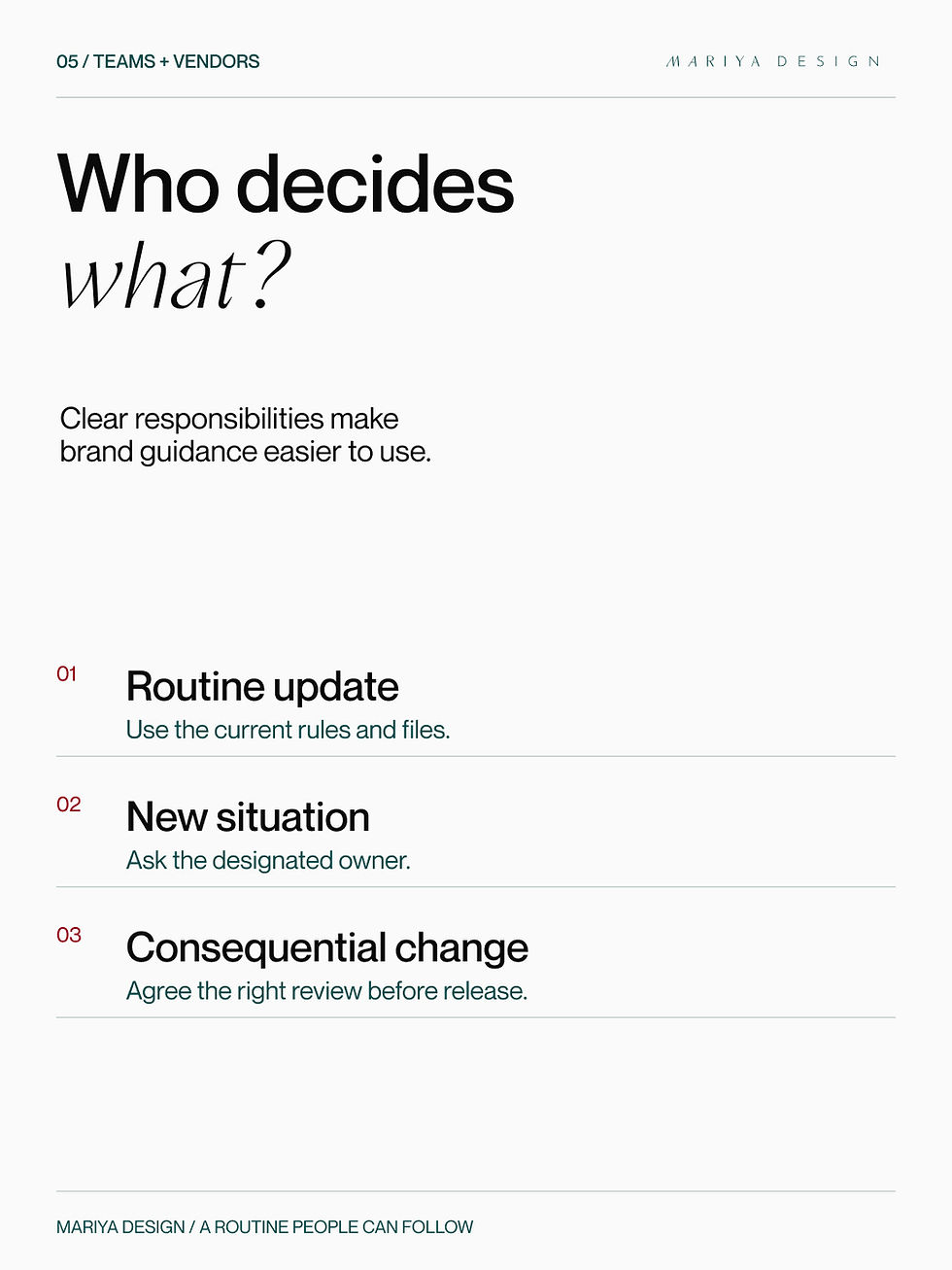
State which parts are fixed, which can adapt under the existing rules, and which require a new design decision. Give an example close to the assignment. If the situation has not been resolved, mark it as an open question rather than leaving a partner to infer an answer from unrelated work.
Distinguish design direction from production artwork
A mockup or presentation image communicates an intended appearance. It should not be assumed to contain everything needed for manufacture. Likewise, a visual layout does not confirm the feasibility of a structure, finish, or material.
Identify the status of what you are sending: reference, design direction, artwork for review, or approved artwork for the agreed application. Name the separate technical, content, and production approvals that still apply.
In my projects, design, production artwork, and printer liaison are scoped according to the assignment. Manufacturer sign-off, proof or press approval management, and end-to-end production ownership are separate responsibilities that need explicit agreement.
Give unfamiliar work an appropriate checkpoint
A new supplier or application may benefit from an early sample review before the whole batch is developed. Agree what that review covers and who can approve it. Established repeat work can follow a simpler route when the relevant checks remain in place.
Clear guidance reduces avoidable questions. It does not make every approval unnecessary, and it cannot prevent someone from overlooking an instruction. The handoff should make a mistake easier to notice and resolve.
Keep corrections attached to the source
If a partner uses an old asset, correct the output and the access path that led to it. If several people misread the same instruction, revise the explanation or add an example. A correction sent in one email may never reach the next person doing the work.
For SAE-REN, the identity spans beauty packaging, digital, and a physical beauty environment. Different applications call for different instructions, even when they share the same visual language. This is why the handoff needs to be tailored to the work in front of the recipient.
A short check before sending
Can the recipient identify the task, the current files, the permitted adaptations, the outstanding questions, and the person responsible for approval? If any answer is unclear, the handoff needs another sentence or a more relevant reference.
For the wider internal routine, read how to prevent brand inconsistency. For the content of the guidance itself, read why brand guidelines fail.
If your partners repeatedly need to recreate missing parts of the identity, share the applications involved so I can recommend the right scope of work.