Why Your Brand Doesn’t Look Premium, Even If the Product Is Good

Updated: Sep 12
The product is good.
The formulation is thoughtful. The materials are considered. The service is credible. The founder has invested in quality. The customer experience may even be strong once someone buys.
But from the outside, the brand does not communicate the same level of value.
The packaging feels ordinary. The website looks less considered than the product. The photography changes from one campaign to another. The social content makes the business feel smaller than it is. The visual identity may look polished, but not particularly premium.
This creates a difficult gap:
The quality exists.
The perception does not match it.
A premium brand is not created by adding black, gold, serif typography, or expensive-looking mockups.
Premium perception comes from repeated signals that make the product, brand, and customer experience feel aligned.
When those signals are weak or inconsistent, even a very good product can appear less credible, less distinctive, or less valuable than it really is.

Product quality and perceived quality are not the same thing
Product quality is what the customer receives.
Perceived quality is what the customer expects before they buy.
That expectation is shaped by everything surrounding the product:
packaging
website
photography
typography
color
language
product naming
layout
materials
content
sales presentation
customer-facing details
A customer cannot evaluate the full quality of the product before purchase.
They rely on signals.
Those signals help them decide:
Does this feel trustworthy?
Does this feel considered?
Does this justify the price?
Does this brand understand its market?
Does the experience feel consistent with the promise?
Does this look like something I would choose over the alternatives?
A good product may eventually prove its value.
The brand has to communicate enough of that value before the customer reaches that point.

Why some brands look expensive but still do not feel premium
A brand can use the familiar language of luxury and still feel unconvincing.
Black packaging. Metallic foil. A high-contrast serif. Minimal layouts. Muted photography. Large amounts of white space.
These choices can support premium perception.
They cannot create it on their own.
When the structure behind them is weak, they become styling.
The brand may look expensive in one image, but the effect disappears when the customer moves to the website, product page, email, packaging, or social content.
Premium perception is not one visual treatment.
It is the consistency of the full experience.

1. The product and the presentation belong to different quality levels
One of the most common problems is a mismatch between the quality of the offer and the quality of the brand around it.
The product may be carefully developed, but the packaging feels generic.
The service may be highly specialized, but the website looks like a template.
The ingredients may be premium, but the photography does not communicate material quality.
The founder may have strong expertise, but the visual identity does not create enough authority.
This mismatch creates doubt.
Customers may not consciously think the brand looks cheap.
They may simply feel less confident about the price, quality, or credibility of the offer.
The product is carrying more of the burden than it should.
2. The brand relies on decoration instead of hierarchy
Premium brands often feel calm because the customer knows where to look.
The information has an order.
The product leads. The message is clear. The supporting details do not compete. The brand does not try to prove everything at once.
A brand can use beautiful typography, photography, and color while still lacking hierarchy.
Everything may look carefully designed, but the customer is left asking:
What is the product? Why is it different? What should I notice first? Why does it cost this much? What should I do next?
When every element has equal visual weight, the brand feels less confident.
Premium perception needs restraint, but restraint only works when the hierarchy is clear.
3. The website weakens the packaging
Packaging may be the strongest part of the brand.
Then the customer reaches the website and the experience changes.
The typography behaves differently. The color balance shifts. The photography loses consistency. The layouts feel more crowded. The language becomes generic. The product no longer feels as considered as it did in the original campaign.
This creates a break in perception.
The website does not need to look identical to the packaging.
It does need to feel like the same brand.
Premium perception weakens when one touchpoint creates desire and the next introduces doubt.
4. The photography does not support the positioning
Photography carries a large part of premium perception.
It communicates:
material quality
scale
texture
context
atmosphere
audience
price level
product experience
Strong photography is not only about using a professional camera.
The direction has to be right for the brand.
A wellness product photographed like a mass-market supplement will feel different from the same product presented through controlled light, material detail, and a clear visual world.
A beauty brand may have attractive images, but if every campaign uses a different art direction, recognition weakens.
A food or beverage product may look artisanal in one image and highly commercial in another.
Photography should not be treated as decoration added after the identity.
It is part of how the brand communicates quality.
5. The brand changes personality across touchpoints
The packaging feels refined.
The website feels clinical.
The social content feels casual.
The email language feels promotional.
The sales deck feels corporate.
Each touchpoint may be acceptable on its own.
Together, they create an unstable impression.
Premium brands do not need to behave identically everywhere.
They do need a recognizable point of view.
The tone can adapt by context without becoming a different personality.
When language, imagery, layout, and hierarchy change too much, the customer has to keep reassessing the brand.
That weakens trust.

6. The details do not support the price
Premium perception is often lost through details that appear small:
weak spacing
inconsistent typography
generic icons
poor image crops
crowded packaging panels
default website components
unclear product naming
inconsistent capitalization
low-quality mockups
mismatched materials
weak mobile layouts
repetitive promotional language
None of these issues alone may destroy the brand.
Together, they affect how considered the business feels.
A premium price creates higher expectations.
Customers notice when the product promise is stronger than the execution around it.
7. The brand looks premium only in controlled situations
A brand may look excellent in the original identity presentation.
The logo is shown at the right scale. The photography is carefully selected. The mockups are polished. The layouts are spacious. Every application is art-directed.
Then real use begins.
A longer product name appears. A new SKU is introduced. A retailer requests another format. A social template needs more text. A developer rebuilds the page. A vendor adapts the packaging. A campaign needs to launch quickly.
The brand starts to lose the original quality because the identity was designed for ideal examples, not real conditions.
A premium brand identity has to survive practical use.
That requires more than an attractive presentation.
It requires enough structure to adapt without losing the qualities that made the brand feel premium in the first place.

Example: SAE-REN Beauty Lounge
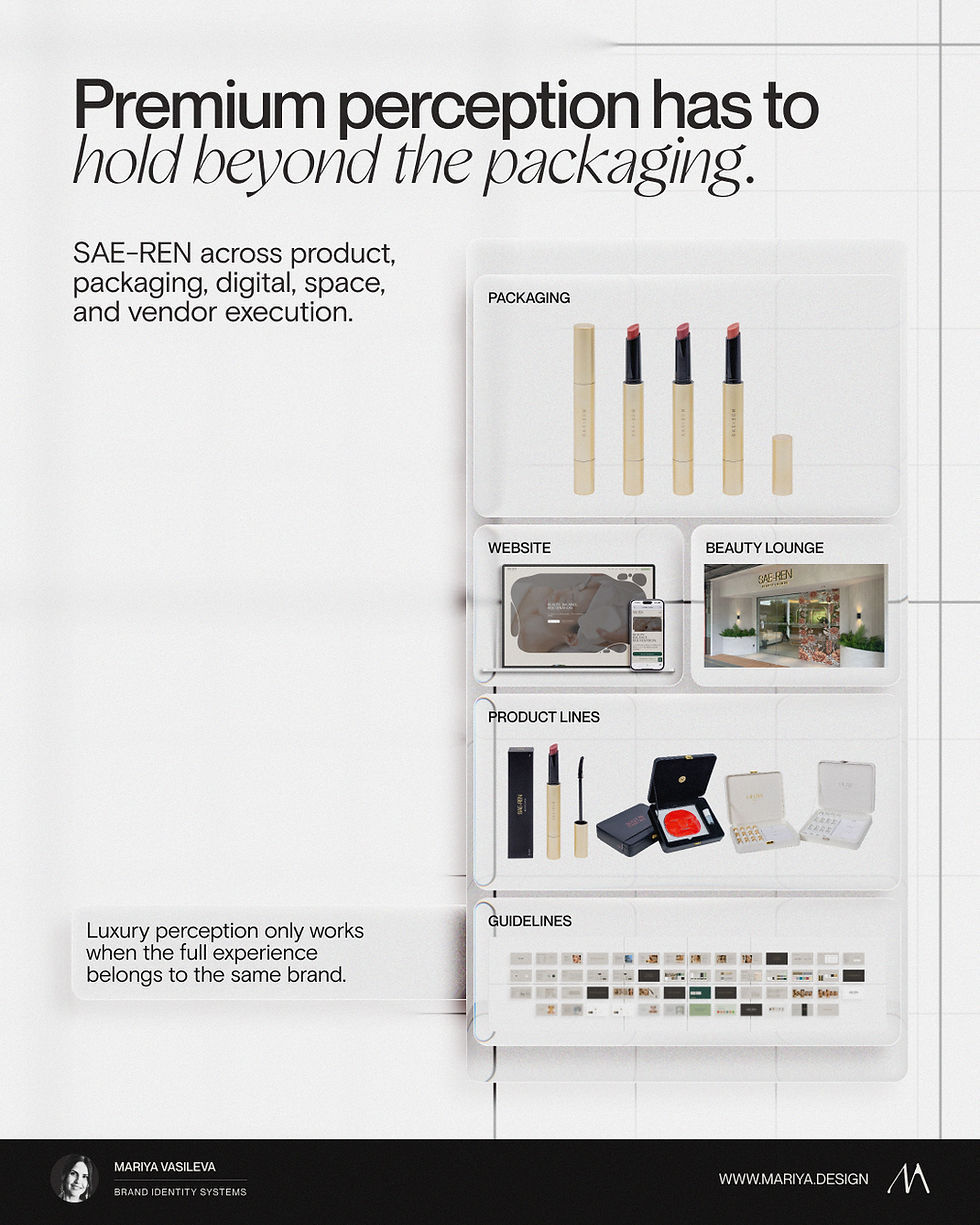
SAE-REN needed the brand to work across skincare, makeup, packaging, a physical beauty lounge, website design, production files, and vendor execution.
The challenge was not simply to make each individual touchpoint look luxurious.
The wider brand experience needed to communicate the same level of quality across product, space, digital, and customer-facing materials.
The identity system helped the brand stay recognizable and controlled without treating every new product, page, or application as a separate creative direction.
→ View the SAE-REN case study
Example: VKA
VKA had valuable history, product credibility, and established market experience.
But fragmented legacy identities, inconsistent packaging, and disconnected digital presentation weakened how clearly that value was perceived.
The rebrand did more than modernize the appearance.
It brought the identity, packaging, website, and customer-facing materials into a more unified system so the brand could communicate its quality with greater clarity.
→ View the VKA case study

Why copying luxury references rarely solves the problem
It is easy to collect references from premium brands.
A restrained cosmetics label. An editorial fragrance campaign. A minimalist hospitality website. A luxury serif typeface. A monochrome packaging system.
But references only show the visible result.
They do not explain why those decisions work for that specific brand.
A copied visual language may look attractive, but still feel disconnected from:
the product
the audience
the category
the price
the business model
the brand’s existing equity
the customer experience
Premium perception cannot be borrowed whole.
The brand needs its own logic.
Without that, the result often looks like an imitation of premium branding rather than a credible premium brand.
What to diagnose before redesigning
A brand that does not look premium may not need a complete rebrand.
The problem could be:
inconsistent execution
weak hierarchy
poor packaging and website alignment
unclear positioning
weak photography direction
mismatched typography
diluted brand personality
insufficient trust signals
generic visual choices
an identity that no longer supports the price or product quality
The correct next step depends on the cause.
Sometimes the existing identity has strong equity and needs refinement.
Sometimes the direction is right, but the application is weak.
Sometimes the brand has outgrown the original visual identity.
Sometimes the entire perception needs to be reset.
Diagnosis should come before decoration.
What a Strategic Brand Audit identifies
A Strategic Brand Audit reviews how the brand is currently perceived and applied across key customer-facing touchpoints.
It identifies:
where premium perception weakens
where the product and presentation feel mismatched
which touchpoints feel disconnected
what should be preserved
what should be refined
what may need to be rebuilt
whether a rebrand is actually necessary
The audit does not create a superficial luxury treatment.
It clarifies what is preventing the brand from communicating the quality that already exists in the business.

A good product still needs the right signals around it
Product quality matters.
But customers cannot experience all of that quality before they decide whether to trust, explore, inquire, or buy.
The brand has to communicate enough of the value first.
That does not mean making everything look expensive.
It means creating the right relationship between positioning, hierarchy, packaging, website, photography, language, and execution.
A strong product deserves a brand that communicates the same standard.
Start with diagnosis
A good product should not rely on visual polish alone to communicate quality.
The brand needs to create confidence across positioning, packaging, website, photography, language, and customer experience.
If the product is strong but the brand still feels generic, inconsistent, or difficult to trust, the next step is not automatically a luxury redesign.
The first step is understanding where premium perception weakens.
Is the positioning clear enough to support the price?
Does the hierarchy make the value easy to understand?
Do packaging and website communicate the same standard?
Does the photography feel specific to the brand?
Are trust signals visible before the customer has to search for them?
Is the identity distinctive, or only borrowing familiar premium codes?
That is what the Strategic Brand Audit is designed to clarify.
Need to understand why the brand does not look as premium as the product or service behind it?
I’ll review the positioning, identity, packaging, website, and customer journey, then recommend the right starting point.


