What Is a Brand Identity System? A Practical Guide for Premium Brands

Updated: Sep 12
A brand identity system defines how a brand looks, behaves, adapts, and stays consistent when it has to work in the real world.
Looking for the service? Explore Brand Identity System engagements for premium and luxury-led brands.
That is different from having a logo, a palette, a few fonts, and a polished presentation.
Those elements can make a brand recognizable. A system explains how they should work together across packaging, website, content, campaigns, product lines, teams, vendors, and future decisions.
This difference becomes more important as a brand grows.
At the beginning, a founder or one designer may be making most visual decisions. Consistency can be maintained through memory, taste, and direct approval.
Then more products, pages, people, formats, and partners are added.
Every new touchpoint creates another decision.
Without a system, those decisions slowly become separate interpretations of the brand.

What is a brand identity system?
A brand identity system is the structure behind the visible brand.
It defines what stays fixed, what can flex, how information is prioritized, how visual elements behave, and how the brand should extend into new situations without becoming a different version of itself.
A working identity system can define:
logo architecture and usage
typography hierarchy
color roles
layout and composition logic
image and art direction
packaging hierarchy
product and SKU structure
digital behavior
campaign flexibility
application rules
vendor and production standards
documentation for future use
The goal is not to create more design assets.
The goal is to make future design decisions clearer.
When the system is strong, the brand becomes easier to use without becoming generic or rigid.
Visual identity vs brand identity system
Visual identity is the visible language of the brand.
It includes the logo, typography, color, imagery, graphic elements, and general visual character.
A brand identity system includes those elements, but also defines how they behave across different conditions.
A visual identity may show a beautiful homepage, package, social post, and business card.
A system asks what happens when the product name becomes twice as long, a second collection launches, the website needs a new page type, a retailer requests another format, or a vendor has to adapt the files without the original designer present.
That is where the difference becomes practical.

Brand guidelines vs brand identity system
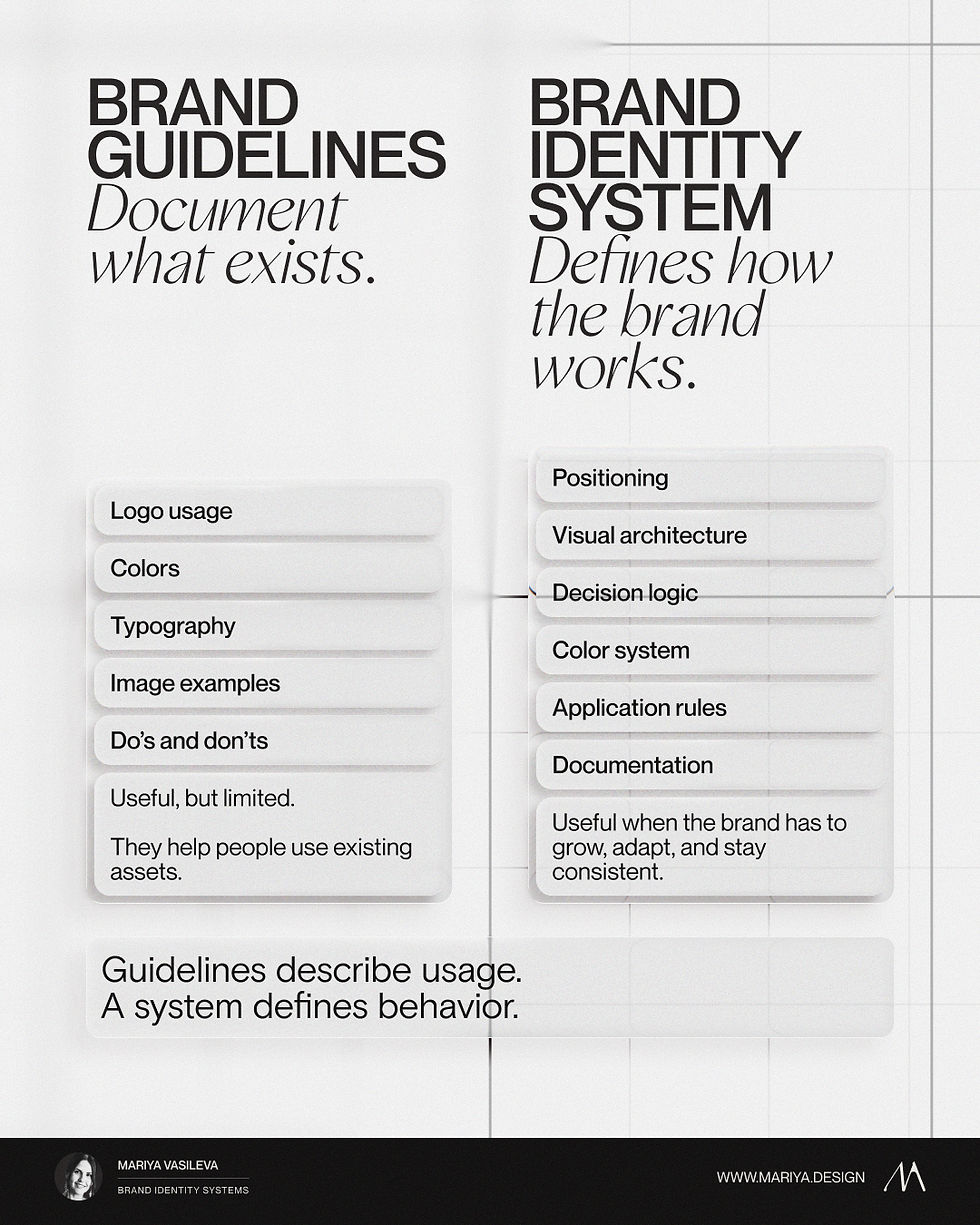
Brand guidelines and brand identity systems are closely connected, but they are not the same thing.
Guidelines document decisions.
A system defines the structure and logic behind those decisions.
A guideline document may tell someone which logo to use, which colors are approved, and which typefaces belong to the brand.
That is useful, but it may still leave important questions unanswered.
Which color leads on packaging? How should a new SKU be differentiated? What happens when there is more information than the sample layout? How much can a campaign flex? Which elements create recognition when the logo is small or absent? How should a vendor translate the system into a new production format?
If those decisions are not defined, the guidelines still require interpretation.
Different people interpret them differently.
That is how consistency becomes manual again.
The five layers of a useful brand identity system
A premium brand identity system needs more than visual polish. It needs enough structure to support real decisions.
1. Positioning and perception
Before the identity can behave consistently, the brand needs to know what it is trying to signal.
Who should trust it? What level of quality should it communicate? What should feel distinctive? What should feel familiar enough for the category? What perception should the customer carry from one touchpoint to the next?
Without this layer, visual decisions are often chosen because they look attractive rather than because they support the right perception.
2. Visual architecture
Visual architecture defines the core identity elements and the hierarchy between them.
This includes logo structure, typography, color, imagery, composition, graphic devices, and the relationships that make those elements recognizable as one brand.
The important part is not simply choosing the elements. It is deciding which ones lead, which support, and how they combine without competing.
3. Application logic
Application logic explains how the identity moves into real formats.
Packaging has different requirements from a website. A product page has different requirements from a campaign. Social content has different pressure from a sales presentation.
A system should allow those touchpoints to behave differently while still feeling connected.
4. Decision rules
Decision rules reduce the amount of subjective interpretation needed every time something new is created.
They can define how a new product joins the range, how much a campaign can flex, when an accent color is appropriate, what hierarchy is protected, or which visual choices should never be introduced because they weaken recognition.
This is the layer that turns a style into an operating system.
5. Documentation and handoff
The system has to survive after the original design phase.
That means the logic needs to be documented clearly enough for the founder, internal team, developer, supplier, manufacturer, or future creative partner to use it.
Documentation is not the system itself. It is the tool that helps the system remain usable over time.

Where inconsistency usually starts
Brand inconsistency rarely appears because someone intentionally decides to damage the brand.
It starts with reasonable exceptions.
A campaign needs more energy. A new product needs differentiation. The website needs a different component. A retailer requests another format. A team member needs an asset quickly. A supplier adapts a file for production.
Each decision can make sense on its own.
The problem appears when there is no shared logic connecting those decisions.
Over time:
campaigns introduce new styles
new hires interpret the brand differently
new products stretch the visual rules
vendors execute without shared standards
digital and packaging begin to diverge
approvals increase because nobody is sure what is correct
Nothing may look dramatically wrong at first.
But recognition becomes less stable, premium perception weakens, and execution takes more effort.

Why this matters more for premium brands
Premium perception is built through repeated signals.
One strong touchpoint can create interest, but the customer experiences the brand across a sequence of interactions.
Packaging may create desire. The website has to continue the same level of care. The product page has to make the value clear. Photography has to support the positioning. Content has to feel like the same brand. A sales deck or service document has to maintain the same authority.
When those signals agree, the brand feels more established and more believable.
When they contradict each other, the customer has to keep recalibrating what level of brand they are dealing with.
That is why premium perception is not created by one expensive-looking asset.
It is created by consistency of judgment.

When do you need a brand identity system?
Not every business needs a large identity system on day one.
A very early idea with one offer and few touchpoints may only need a clear visual direction for a while.
The need changes when complexity increases.
A brand identity system becomes useful when:
multiple products or SKUs need to stay connected
packaging and website no longer feel aligned
more than one person creates brand materials
vendors or manufacturers need repeatable standards
campaigns keep introducing new visual directions
every new asset requires founder approval
the brand looks strong in presentation but weakens in everyday use
the business is moving into a higher price or perception level
the identity needs to support new markets, channels, or locations
At that point, consistency cannot depend on one person remembering what looks right.
What a useful system should make easier
A useful system should reduce the number of decisions that have to be reinvented, escalated, or approved from scratch.
It should make it easier to decide:
what remains fixed and what can flex
how a new product joins an existing range
how packaging, digital, and content maintain the same hierarchy
how teams and vendors adapt the identity without guessing
when an exception is temporary and when the system itself needs to evolve
This is also what makes a brand scalable as complexity increases.
Verbal identity and brand voice belong inside the system
A visual system can keep the brand recognizable while the language makes it feel like a different company in every channel. Brand voice should not be reduced to three adjectives. It needs the same kind of operating logic as color, typography, and layout: boundaries, repeatable patterns, and rules for adaptation.
A useful voice system defines
Tone boundaries, including what the brand should never sound like
Vocabulary rules for claims, product names, technical language, and recurring phrases
Structural patterns for headlines, explanations, calls to action, and proof
Context shifts for sales, support, social, packaging, editorial, and leadership communication
Consistency does not mean one tone everywhere
A support reply should not sound identical to a campaign headline, and a product label should not carry the same amount of explanation as a long-form article. The voice stays consistent when the underlying point of view, vocabulary, sentence behavior, and level of confidence remain recognizable while the tone adapts to the situation. That is what makes verbal identity scalable rather than repetitive.
How a brand identity system is built
The strongest systems are built in sequence because each stage removes a different kind of uncertainty.
Strategic Brand Audit for existing brands
For an existing brand, the Strategic Brand Audit identifies what is working, what is misaligned, what should be preserved, and what may need to change before more design is created.
This prevents a redesign from becoming the automatic answer to every consistency problem.
Brand Direction Blueprint for new or reset-phase brands
For a new brand or an early-stage reset, the Brand Direction Blueprint defines positioning, perception, visual logic, and decision rules before identity, packaging, website, or launch execution begins.
This gives the visual work a clear foundation instead of asking design to discover the strategy later.
The Vault for the full identity system
Once the direction is clear, The Vault translates it into a complete identity system across visual architecture, application logic, packaging and product structure, digital standards, and documented usage rules.
The point is not to create a larger brand book.
The point is to create a brand that can keep making coherent decisions as the business grows.
What happens without a system
Without a system, every new asset becomes another small design brief.
The website team asks what is on-brand. The social team invents another interpretation. Packaging variants start drifting. Vendors make reasonable guesses. The founder becomes the final approval layer because nobody else has enough structure to judge the work.
This creates more than visual inconsistency.
It creates operational friction.
more approvals
slower execution
repeated redesign
weaker recognition
fragmented premium perception
more dependence on individual taste
higher risk when teams or vendors change
A brand identity system does not remove judgment.
It gives judgment a structure to work from.
A brand identity system should make the brand easier to use
The best system is not the one with the most pages, rules, or components.
It is the one that makes the right decisions easier to repeat.
New products can be added without redesigning the identity. Teams can execute more consistently. Vendors have clearer standards. Packaging, digital, content, and customer-facing materials stay connected even when they are not identical.
That is what turns visual identity into a working brand system.
The logo, typography, color, imagery, packaging, website, and content stop behaving like separate design projects.
They start behaving like different expressions of the same brand.
See this in practice: SAE-REN luxury beauty brand identity system.
Start with diagnosis
If the identity looks strong in isolation but becomes inconsistent across real use, first identify whether the problem is direction, system, or execution.
The Strategic Brand Audit clarifies what should be preserved, refined, rebuilt, or better structured before more execution is commissioned.
Need help choosing the right starting point?
I’ll review your brand and recommend the right starting point.


