Beauty Packaging Trends 2026: Color, Materials & Premium Design

Updated: Sep 12
Beauty packaging trends move quickly because the category lives in two places at once.
On shelf, the product has to be recognized, understood, and trusted quickly.
On screen, it has to stop someone long enough to make them care.
That pressure is why color trends matter in beauty. A fresh palette can make a skincare, makeup, fragrance, or wellness product feel current. It can help a launch stand out. It can create visual energy around a new product line, seasonal collection, or campaign.
But trend color is not the same as brand color strategy.
A premium beauty brand cannot rebuild its identity around every seasonal color shift.
The stronger question is not only:
“What colors are trending in beauty packaging for 2026?”
The better question is:
“Which colors can support the brand, product range, packaging materials, website, and customer perception without weakening recognition later?”
That is where most beauty packaging decisions become more serious than they look.

Beauty packaging trends in 2026 are not only about color
Color is usually the first thing people notice.
But packaging color does not work alone.
A green tube, mauve lipstick, black serum bottle, beige carton, or red accent only becomes meaningful when it sits inside a wider visual system.
The typography, label hierarchy, finish, substrate, product name, photography, website, and surrounding brand world all change how that color is perceived.
A soft green can look fresh and clinical in one identity. It can look generic and “natural product” in another. A deep black can feel luxurious, but it can also look heavy or predictable if the typography and material quality are weak. A nude beige can feel refined and skin-adjacent, or it can disappear completely if the brand has no contrast, texture, or hierarchy.
The color is not the full decision.
The system around the color decides whether it works.
When packaging, website and product lines need to operate as one identity, that logic belongs inside a complete brand identity system.
See this applied across packaging and digital touchpoints in the SAE-REN beauty brand identity case study.
Want the color references?
Download the 2026 Beauty & Wellness Color Guide with HEX, RGB, CMYK, and Pantone references for trend and timeless palettes.
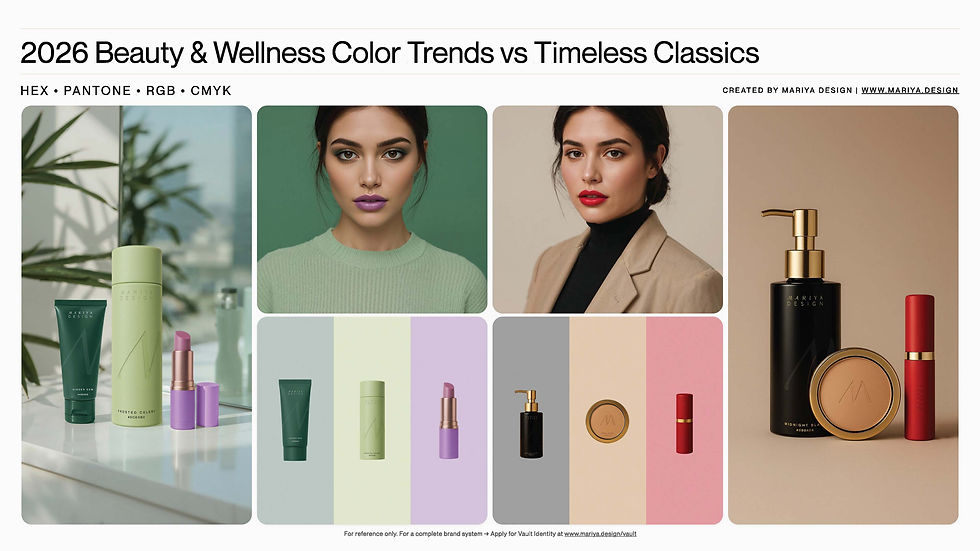
The 2026 beauty packaging trend palette: fresh, soft, and slightly unexpected
The current beauty direction is still moving toward freshness, softness, and more sensory color. The strongest trend colors are not loud for the sake of being loud. They feel natural, but with a twist. Familiar, but less expected.
Hidden Gem
Hidden Gem is a deep green that can give beauty packaging a grounded, fresh, and slightly richer tone.
It works well when the brand needs a natural or botanical signal without looking too soft. On primary packaging, it can create depth. As a supporting color, it can make a lighter system feel more serious.
The risk is overusing it as a generic “clean beauty” signal.
Green does not automatically create trust. It needs to be supported by typography, ingredient hierarchy, finish, and enough distinction from the many wellness and skincare brands already using botanical cues.
Frosted Celery
Frosted Celery is a lighter green-yellow tone that feels airy, soft, and fresh.
It can work beautifully for skincare, body care, wellness beauty, and products that want a gentle natural cue without going fully earthy.
It is strongest when used with enough contrast.
On the wrong material, or next to weak typography, it can become pale and hard to read. On larger surfaces, it needs careful testing because light greens can change quickly across paper, plastic, glass, labels, and digital screens.
This is a good example of a color that may look beautiful in a palette and still fail in production.
Iridescent Mauve
Iridescent Mauve brings a more creative and cosmetic feeling into the palette.
It can work well as an accent for caps, details, secondary packaging, limited editions, or campaign graphics. It gives the brand a cooler, more expressive tone without becoming as loud as hot pink or violet.
The risk is making it carry too much of the brand.
As a controlled accent, it can feel modern and memorable. As the main foundation, it may date faster unless the brand has a strong reason to own that direction.

Trend colors are useful when they have a role
The mistake is not using trends.
The mistake is asking trend colors to do the job of a brand system.
A trend color can be useful when it has a defined role. It can signal a new launch, separate a product variant, give energy to a seasonal campaign, or create contrast inside a more stable identity.
It becomes risky when it replaces the brand’s core recognition.
For a premium beauty brand, I would usually ask:
Is this color an anchor, an accent, a product-line marker, or a campaign layer?
Those are different roles.
An anchor color needs to survive years of use. It has to work across packaging, ecommerce, content, photography, email, and future products. It needs enough depth and flexibility to carry recognition.
An accent color can be more expressive. It can create energy, emphasis, or contrast without carrying the whole brand.
A product-line color needs to separate variants clearly without making the range feel fragmented.
A campaign color can be more temporary. It can attract attention without becoming part of the permanent identity.
This is where beauty brands often get into trouble. They find a trend color that looks exciting, then overuse it as if it were a timeless brand asset.
Some colors are better as weapons than foundations.
Building a premium beauty or wellness brand?
Download The Luxury Brand Identity System Guide to see how visual identity, packaging, color, digital presence, and perception work together.
Timeless beauty codes still matter
Trend colors bring freshness, but beauty brands still rely on certain long-term visual codes because they carry recognition and trust.
Midnight Black, nude beige, and classic red are not new. They are not exciting in the same way as a trend forecast. But they continue to work because they carry strong beauty associations.
Midnight Black
Midnight Black can signal authority, luxury, performance, or ritual.
It works especially well for high-value SKUs, fragrance, makeup, professional beauty, and products where the brand wants depth and confidence.
But black is not automatically premium.
It needs material quality, controlled typography, and enough contrast. A black package with poor print quality, weak hierarchy, or generic gold accents can look cheaper than a lighter, more controlled system.
Nude Beige
Nude Beige is useful because it sits close to skin, softness, care, and calm.
It works well in skincare, body care, complexion, wellness beauty, and brands that want warmth without becoming overly colorful.
But beige is not a luxury formula.
Beige can be beautiful. The problem is not the color. The problem is when it becomes a default answer for “premium” without texture, hierarchy, contrast, or a clear brand point of view.
Classic Red
Classic Red carries a long history in beauty.
It can signal confidence, glamour, sensuality, performance, or heritage depending on how it is used. In cosmetics, especially lip color and makeup, red has immediate category recognition.
The challenge is precision.
A red that works beautifully for one beauty brand can feel too loud, too commercial, too retro, or too cosmetic for another. It needs the right typography, finish, surrounding palette, and product context.

Trend vs timeless is a business decision
The strongest beauty packaging systems do not choose between trend and timeless.
They decide what each one is allowed to do.
Trend colors are useful for attention. Timeless colors are useful for recognition. A good packaging system knows which role matters more for each product.
A new product launch may benefit from a fresher, more expressive color. A limited edition can carry more risk. A collaboration can use a more visible palette because its job is short-term attention.
A core serum, moisturizer, cleanser, fragrance, or hero product usually needs a more stable visual foundation.
That does not mean it has to look boring.
It means the brand should not rebuild recognition every time the market changes.
For premium beauty brands, consistency is part of perceived quality. Customers may not consciously analyze the color system, but they notice when the range feels controlled. They also notice when each SKU looks like it belongs to a different brand.

A color trend has to survive the material
Beauty packaging color has to survive more than a moodboard.
A color may look perfect on screen and weaker on the actual pack. It may shift on paper. It may flatten on plastic. It may look different on glass, aluminum, foil, label stock, or a coated carton. It may photograph differently under studio light, bathroom light, retail light, or natural daylight.
This is where color strategy becomes practical.
The question is not only whether the color is attractive.
The question is whether it performs across the materials and situations the brand actually uses.
For beauty packaging, that means testing color against:
material
finish
print method
product photography
ecommerce thumbnails
retail shelf contrast
ingredient and usage information
variant recognition
mobile product pages
A pale trend color may look elegant in a campaign image and disappear in a thumbnail.
A deep color may feel premium in a render and become too heavy in a physical bottle.
A metallic or iridescent effect may feel beautiful in motion and difficult to reproduce consistently with suppliers.
This is why premium beauty packaging cannot depend only on trend forecasting.
It needs production-aware color decisions.
Premium beauty packaging needs hierarchy
Color can attract attention, but hierarchy helps the customer understand the product.
This is where many beauty brands weaken their packaging.
They choose a beautiful palette, then place the product name, ingredient callouts, benefits, usage details, claims, and brand elements without enough order.
The result may look designed, but not clear.
A premium package has to decide what leads.
Is the brand name the main signal? Is the product system the main structure? Is the hero ingredient the strongest buying cue? Is the product benefit more important than the formula name? Does the range need numbered steps, color-coded variants, or a more editorial structure?
Color should support those decisions.
It should not replace them.
A beautiful green, mauve, black, beige, or red will not fix packaging hierarchy if the customer cannot understand what they are holding.
Beauty packaging and digital need to match
Beauty products are rarely judged only on the physical package.
A customer may discover the product through Instagram, then visit the product page, compare the ingredients, check reviews, and return later through an email or ad.
The packaging and website need to feel connected.
They do not have to look identical. Packaging and digital have different jobs. But the typography, color roles, imagery, product hierarchy, and tone need to feel like they belong to the same brand.
This is where a lot of premium beauty perception breaks.
The packaging looks considered, but the website feels generic. The product page does not carry the same level of care. The photography is beautiful, but the layout weakens it. The trend color appears on packaging, but behaves differently online.
The customer may not know why the brand feels less premium.
They just feel the gap.
When packaging color becomes a brand identity problem
A color decision becomes a brand identity problem when it starts affecting recognition, consistency, production, or customer perception.
That usually happens when the product range grows.
One trend-led launch becomes three. A limited palette becomes part of the core line. New SKUs are added quickly. A supplier changes material. The website introduces new shades. Campaigns add extra colors. Social content keeps adapting the palette to fit current trends.
At first, the brand still looks active and fresh.
Then it starts to look inconsistent.
The issue is not the color itself.
The issue is that the brand does not have a clear color system.
For a premium beauty brand, color should help the brand grow without losing recognition. It should define what stays fixed, what can flex, and how new products are added without making the range look accidental.
That is the difference between a palette and a brand color system.
The 2027 Beauty Packaging Trends follow-up shows how emerging signals can be translated into controlled color systems rather than copied as isolated palettes.
What to do before using 2026 beauty packaging trends
Trend research is useful.
But before applying a trend color to a beauty brand, I would check the brand system first.
Is there already a recognizable anchor? Are product lines clearly separated? Does the packaging hierarchy support the buying decision? Do the colors work on the actual materials? Does the website continue the same logic? Can new SKUs be added without diluting recognition?
If the answer is unclear, the trend is not the first problem.
The structure is.
A beauty packaging trend can help a product feel fresh in 2026.
But the brand still needs a system that can hold beyond the trend cycle.
That is how beauty packaging stays current without losing premium perception.
In the beauty industry, your packaging is your promise. It is the single most critical asset for winning on a crowded shelf and a saturated social feed. A miscalculation in color strategy is a mistake in business strategy.
This is not a list of trends; it is a strategic playbook. Here, you'll see how the rising 2026 beauty packaging trends stack against timeless classics, giving you the intelligence to build a brand that wins.


